

Choosing the right platform matters more for an online store than for almost any other kind of website, because the platform decides what your checkout can look like and how fast the whole thing loads. Webflow’s appeal for e-commerce is design control: you shape the product pages, the browsing experience and the checkout rather than accepting a fixed theme structure.
That means custom product pages with room to tell a story, animation where it helps rather than where a theme allows it, and clean output that loads quickly. This guide covers what Webflow actually gives you for e-commerce, how to structure a store properly, and where Webflow is genuinely the wrong choice.
Why Webflow is perfect for eCommerce?
Webflow bundles the core commerce features with genuine design freedom, which is an unusual combination.
Easy Product Management:
Adding products is straightforward: upload images, write descriptions, set prices. Variants for size and colour are handled natively, and inventory is tracked automatically so stock levels stay accurate as orders come in.
Flexible Shipping Options:
You control how shipping is calculated: flat rates, or rates derived from weight or order value. Shipping zones let you treat local and international customers differently, which is usually necessary as soon as you sell across a border.
Secure Payments:
Webflow works with established payment providers including Stripe and PayPal, so customers can pay by card, Apple Pay or Google Pay. The checkout is secure by default, which removes a common source of buyer hesitation.
Custom Checkout Experience:
Most platforms lock you into their standard checkout page. Webflow lets you design yours, so the last and most important step of the purchase still looks like your brand rather than someone else’s.
Design Freedom:
Full control over layout, colour, typography and interaction. Every page, section and element is yours to shape, which is the main reason design-led brands choose Webflow over a themed platform.
Micro-Interactions & Animations:
Small confirmations, such as an add-to-cart response or a button hover state, tell the customer their action registered. Used sparingly this genuinely helps; used everywhere it slows the page and distracts from the product.
Privacy & Security:
SSL and encryption are handled for you, and hosting is managed, so you are not maintaining security patches yourself. Note that this covers the platform: your own obligations around customer data and privacy policy still apply in your territory.
Integration Capabilities:
Payment services, CRM, email marketing and analytics all connect without custom development, which is what keeps a small store manageable by a small team.
Where Webflow Is Not the Right Choice
Worth saying plainly rather than discovering after you build. Webflow suits focused catalogues and design-led brands. It strains when you have thousands of products with deep variant matrices, complex multi-warehouse inventory, multi-channel selling across marketplaces, or subscription billing.
If that describes your business, a dedicated commerce platform is the better tool and a Shopify build will serve you better. Webflow vs Wix vs Shopify compares the three on architecture rather than marketing claims.
Webflow Design Guidelines for eCommerce
Product Management: Build flexible catalogues with detailed descriptions, high-quality images and variants, organised into categories people can actually navigate.
Customizable Checkout & Cart: Design cart and checkout for clarity. Order summaries, sensible input fields and discount code entry, with Stripe, PayPal, Apple Pay or Google Pay connected.
Create Components: A component is a reusable part of the site. Design your navigation bar or product card once, change it once, and it updates everywhere.
Shipping & Tax Settings: Configure zones and rates by region, and set tax to calculate by location and product type. Get this wrong and it surfaces at checkout, which is the worst possible moment.
Discounts & Promotions: Fixed-amount, percentage or free-shipping codes, with usage limits and minimum order values.
Built-In SEO Optimization: Editable meta titles, descriptions and image alt text. Product pages are usually a store’s largest source of organic traffic, so this is worth doing properly rather than leaving to defaults.
Use Color & Contrast: Make call-to-action buttons genuinely stand out against their background. It is a small thing that measurably affects how many people reach checkout.
Use a Style Guide: Set global styles for brand colours, fonts and buttons. Every new page and product then follows the same rules automatically, which is what keeps a growing store looking coherent.
Order Management Dashboard: Track order status and detail from one place so fulfilment does not depend on searching your inbox.
Order Item Detail: The order item record captures exactly what the customer chose, including product name, price, quantity and any selected options.
How to Organize a Webflow eCommerce Site
On product pages, show clear images from several angles and in each colourway. Surface related products and bundles. Include genuine customer reviews and answer the questions buyers actually ask. Keep the add-to-cart button large and unmissable.
A complete store needs more pages than people expect: a homepage that leads with your best products, browsable category listings, a simple and trustworthy cart and checkout, a thank-you page, plus FAQ, reviews, search results, privacy policy and a blog. Several of those exist as much for search visibility as for shoppers.
Organise categories with straightforward menus, keep the site fast, and apply consistent colour and typography throughout. Live chat, support tooling and customer accounts all reduce friction as volume grows.
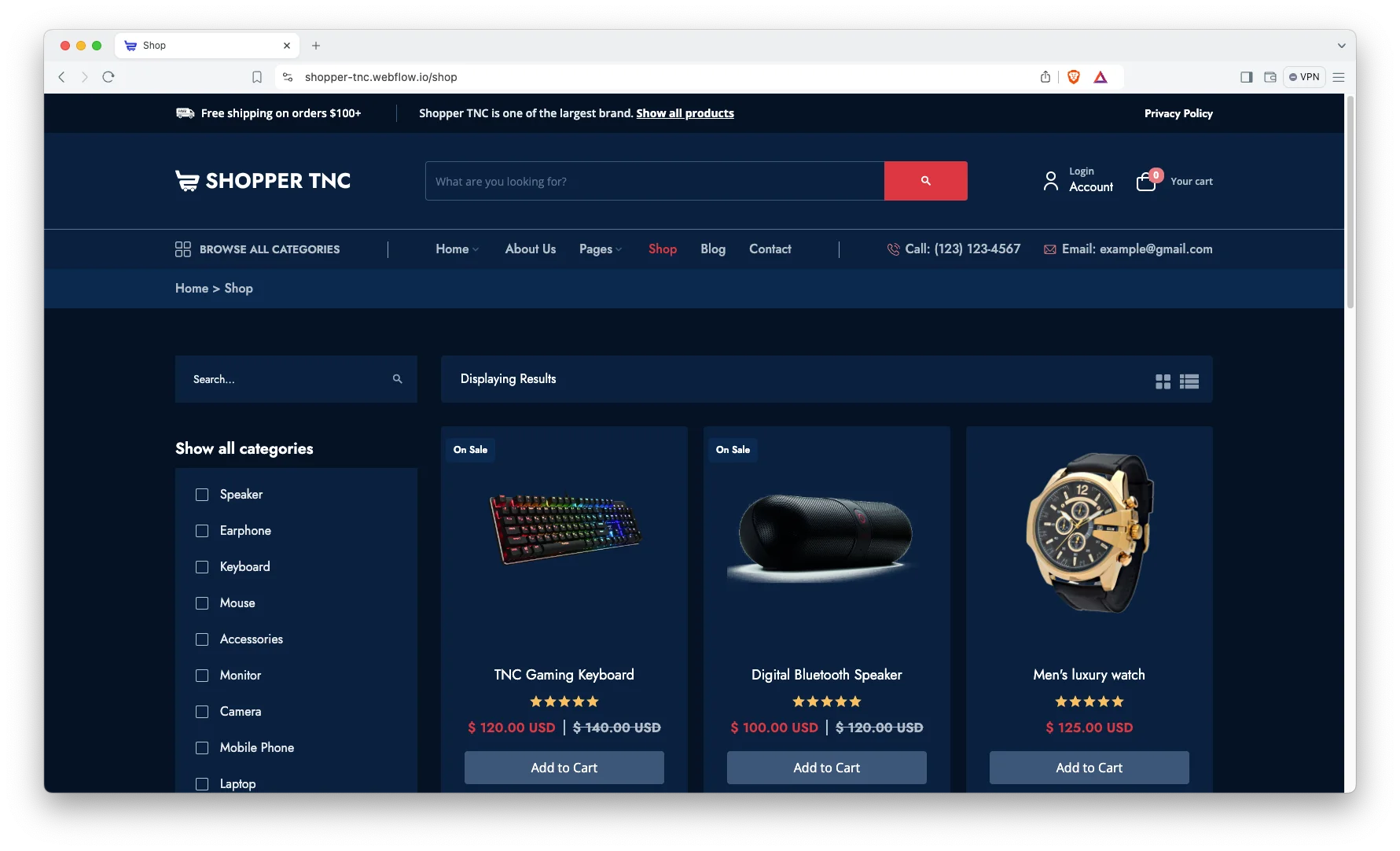
See a well-optimised store structure in the Ecommerce TNC live preview.
Webflow eCommerce Templates Worth Starting From
Building the storefront structure from scratch is the slowest part of launching. A few templates that already model it:
- Ecommerce TNC — the most general-purpose storefront, a sensible default for most product types.
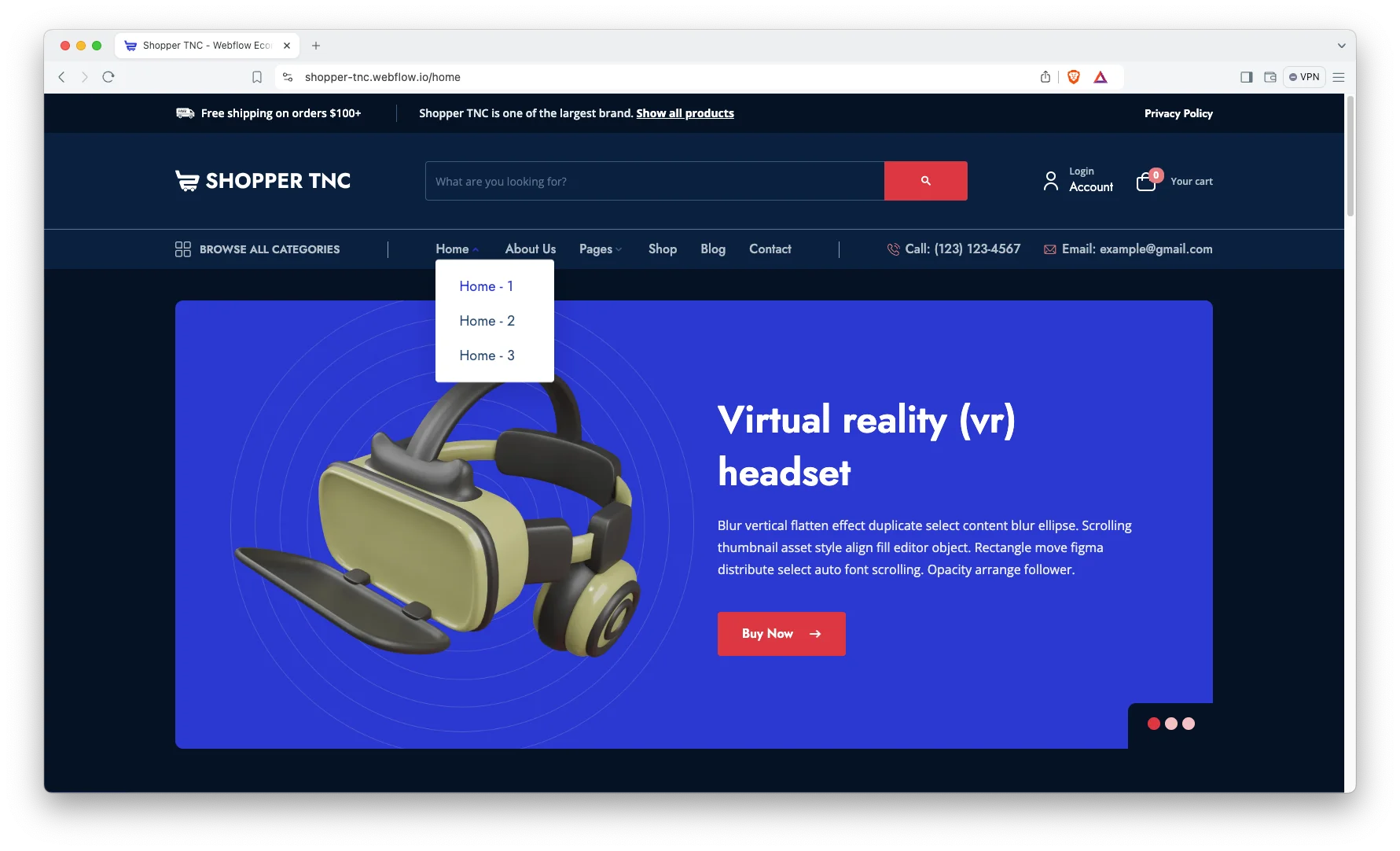
- Shopper TNC — a dark-themed store with ready shop pages, checkout and customer accounts.
- Trendy TNC — fashion and apparel, built around inventory and a secure checkout flow.
- Ornox — jewellery and accessories, where photography has to carry small products.
The full range is in the e-commerce templates collection, and the best Webflow e-commerce templates covers them in detail by product category.
Learn & Build: A Community to Help You
Webflow has a reputation for being hard to learn, which is only partly deserved. It expects you to understand basic layout concepts, but the learning material is unusually good.
Webflow University offers free video courses covering everything from a single page to complex interactions. Working through the commerce material before you build will save you rebuilding the catalogue structure later, which is the most common early mistake.
Final Thoughts
Webflow combines creative control with a capable commerce toolset. You can build a store that looks exactly as you intend, loads quickly and handles product management through to checkout without fighting a theme.
Be honest with yourself about catalogue size and operational complexity first, because that is the one thing a template cannot fix. If Webflow fits, starting from a ready-made store template gets you live in days, and the design and development services are there if you need something built around your business.