

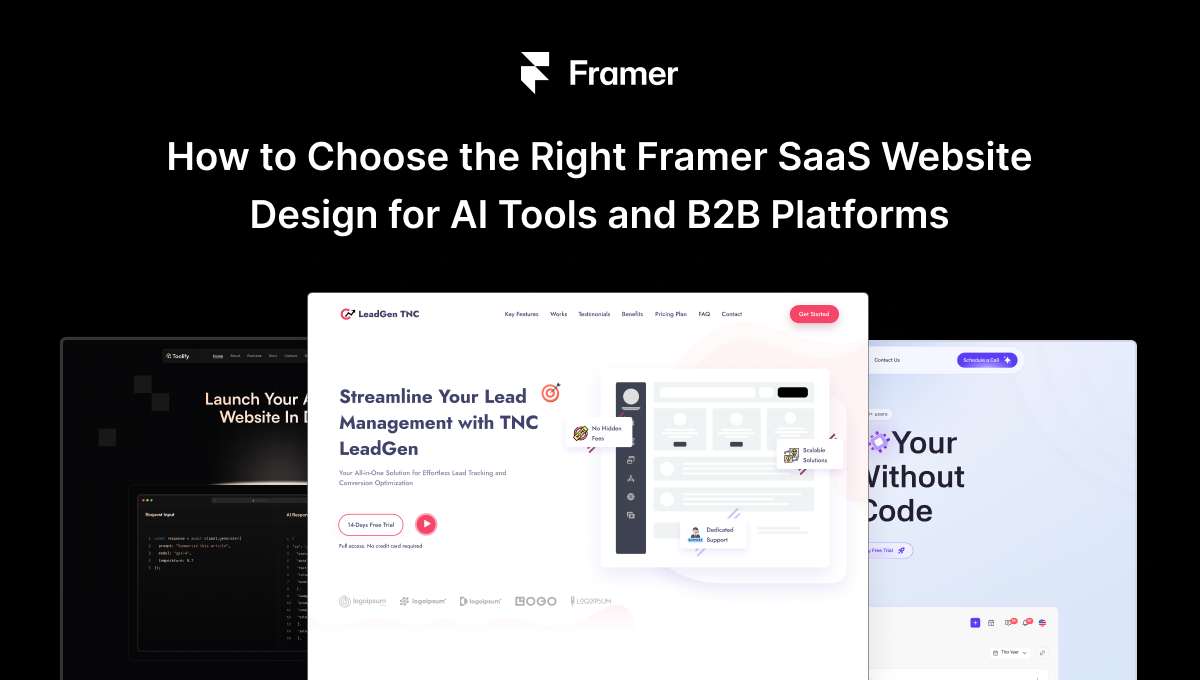
An amazing AI product can still lose potential customers if the website fails to explain its value. Many founders don’t realize this happens. Visitors make quick decisions and if your site feels outdated or difficult to navigate, they’ll move on before they ever understand what you offer. That’s why more startups are investing in professional Framer SaaS website design. A well-designed website helps businesses build trust from the very first visit. It gives you a faster way to launch without spending months on design and development.
In this guide, you’ll learn how to choose the right Framer saas design, which features matter most for AI tools and B2B platforms, and what makes a high-performing SaaS website. We’ll also cover common mistakes to avoid and explain how a well-structured website can increase conversions, strengthen your brand, and support long-term business growth. By the end of this guide, you’ll understand what makes an effective Framer website design for AI and B2B businesses. You’ll also see how the right design helps communicate your value clearly, build trust, and attract more potential customers.
What Makes a Website Design Actually Work for SaaS
A great Framer website design isn’t just about appearance. Here’s what makes a high-performing design deliver better results:
Solves one clear problem: The homepage should speak directly to the single biggest problem your product solves, instead of trying to cover everything at once. Visitors decide fast, so one clear message beats five vague ones.
Shows the product in action: A screenshot or short demo proves your claim far better than a paragraph of text. People trust what they can see working.
Guides toward one next step: Every page should point toward a single action, such as booking a demo or starting a free trial. Too many buttons confuse visitors and often reduce signups.
Loads fast on any connection: Framer SaaS Templates built for speed keep visitors around even on a weak mobile connection. A slow load in the first few seconds often costs you the visitor for good.
Choosing Between Style Options for AI Products
Not everyone expects the same thing from an AI tool. Your style should match the people you’re trying to reach. Here’s how to think about it.
Dark themes with glowing accents: These work well for products that want to feel futuristic, such as a voice cloning tool or a generative design app. The glow effect suggests something advanced is happening behind the scenes.
Minimal white layouts: A plain white background with sharp typography suits serious, businesslike tools, such as an AI tool built for accountants or lawyers. It signals reliability over flash.
Split-screen product previews: A clean split-screen layout, like the one in Toolify, makes product features easier to understand.
Bold color blocks: Younger, more playful brands can use strong color sections to stand out. This works best when your audience is used to consumer apps rather than formal enterprise software.
Sections Every B2B Platform Website Needs
B2B buyers rarely make quick decisions, so your website needs to help convince people who are not even on the call yet. Here is what to include.
Short explainer video: A ninety-second video showing the product in action often does more convincing than several paragraphs of copy, especially for a busy manager skimming your site.
Client logos and names: Even three or four recognizable client names next to your product build instant credibility. People trust a product that other real businesses already use.
Comparison against the old way: A simple table comparing your tool against a spreadsheet or a manual process helps visitors see the value clearly, without needing a sales call first.
Security and compliance section: Larger buyers often check for this before anything else. A dedicated page explaining your data handling can quietly remove a blocker before it ever comes up in conversation.
Where Framer Templates Save Real Time and Money
Framer SaaS Templates change the usual cost and timeline completely. Here is where the savings actually show up.
No separate design and development hires: Instead of paying two different people for design and code, one Framer SaaS Templates purchase already includes both, cutting your highest early cost.
Launch in days, not weeks: That is one reason layouts similar to Scalepro have become popular among startups looking to launch without long design cycles.
Budget freed up for growth: Money saved on the website can instead go toward paid ads, hiring your first support person, or simply extending your runway a few more months.
Fewer revision cycles: Working with an outside agency often means slow back-and-forth emails over small changes. Editing a template yourself removes that entire delay.
How to Customize a Template Without Making It Look Generic
The fear that visitors will notice you used a template is common but usually overblown. Here is how to make it feel like your own.
Rewrite the default text: Every template comes with placeholder copy. Replace all of it in your own voice, since generic text is often the first thing that gives a site away.
Use real product screenshots: Swap any stock images for actual screenshots of your AI tool. This single change does more for authenticity than almost anything else.
Adjust spacing and rhythm: Slightly changing gaps between sections stops the page from feeling like a direct copy of the demo you saw online.
Add one custom detail: A unique icon set or a small custom illustration gives the site a personal touch, even though the underlying structure came from a template.
SEO Advantages Baked Into the Framer Platform
Search engines reward technical basics that many self-built sites quietly get wrong. Here is what Framer already handles well.
Fast loading pages: Page speed is a known ranking factor, and Framer SaaS Templates are generally built with performance in mind from the start.
Mobile-friendly layouts: Since most search traffic today comes from phones, a template that already works well on mobile removes a major ranking obstacle.
Clean heading structure: Search engines use headings to understand page content, and well-built templates already follow proper heading order.
Ready-made alt text fields: Adding alt text to images helps both accessibility and search visibility, and most templates make this simple to fill in as you go.
Matching a Design to Your Growth Stage
Your website needs should change as your company grows, and picking the right template for your current stage matters. Here is how to think about it.
Early stage and pre-revenue: At this point, your site only needs to build clarity and basic trust. Avoid overbuilding with features you do not need yet.
Growing with paying customers: Designs such as Nocomation show how these pages can be organized simply as your product continues to grow.
Scaling with a bigger team: At this stage, a status page and clearer support access become more important, since downtime or bugs affect more paying users.
Avoid building too early: Many founders waste weeks perfecting features for a scale they have not reached yet. Match the template to where you are today.
Mobile Experience Checklist for AI Tool Websites
More than half your visitors will likely open your site on a phone. Here is what to check before launch.
Thumb-friendly buttons: Buttons that were easy to click with a mouse can become frustrating to tap with a thumb, so size and spacing matter more on mobile.
Readable text without zooming: If visitors need to zoom in to read your homepage, most will simply leave instead of adjusting their screen.
Fast-playing demo videos: A demo that lags or buffers on mobile data undoes the entire purpose of showing your product in action.
Clean collapsing menus: Navigation menus should collapse neatly on smaller screens instead of overlapping text or images awkwardly.
How Your Pricing Page Shapes Buyer Trust
Pricing pages get more attention than most founders realize. Here is what builds trust instead of confusion.
Clear plan names: Simple, descriptive plan names work better than vague labels that force visitors to guess what each tier actually includes.
Monthly and yearly costs shown together: Letting visitors compare both options side by side saves them a mental calculation and speeds up their decision.
A short line on who each plan fits: You can see this approach in LeadGen TNC, where simple pricing sections help visitors understand which plan matches their needs.
No hidden fees in fine print: Extra charges revealed only after signup damage trust quickly, and word about this spreads fast among B2B buyers.
Using a Template Design to Test Your Message Before Building More Features
A website does not need to be a finished object built once and forgotten. Here is how to treat it as a living experiment instead.
Launch a simple version first: Get a basic site live and watch what visitors actually click on, rather than guessing what they want.
Change one headline at a time: Testing a single variable at a time makes it clear which change actually affected your signup numbers.
Ask real users what confused them: A handful of honest conversations often reveal more than any analytics dashboard about where visitors get stuck.
Update copy on a regular schedule: Since Framer SaaS Templates are easy to edit, there is no reason to leave outdated copy sitting for months.
Explore the premium template, customize it to match your brand, and build a website that helps your AI or B2B business stand out.
Red Flags to Watch Before You Buy a Template
Not every template listing online is actually worth your money. Here is what to check first.
No working demo link: If you cannot click through a live version before buying, treat that as a warning sign rather than a small inconvenience.
Complaints about support: Reviews mentioning slow or unhelpful customer support usually mean you will be stuck alone if something breaks later.
Outdated design history: A template that has not been updated in over a year may not work properly with newer Framer features or browser updates.
Editor needs code changes: If basic edits require touching code, that defeats the entire point of buying a template in the first place.
Signs Your Website Needs an Upgrade, Not Just a Refresh
Not every problem can be solved with small edits. Here is when a bigger change is actually needed.
Repeated basic questions: If your support inbox keeps answering the same simple question, your homepage is failing to explain that point clearly.
Product has outgrown the copy: If your AI tool has added major features since launch, but the site still describes the old version, visitors are getting an outdated pitch.
Competitors explain things better: When a rival site clearly communicates value faster than yours, that gap tends to show up directly in your conversion numbers.
Support tickets mention missing information: Repeated tickets about details not shown anywhere on your site are a clear signal your website has fallen behind your product.
Final Thoughts
Your website will rarely be the reason someone falls in love with your product, but it can absolutely be the reason they never give it a chance. A confusing or slow site quietly turns away visitors who might have become your best customers. Framer SaaS website design removes that risk by giving founders a fast, professional starting point built specifically for software products.
The best Framer SaaS website design depends on your brand, audience, and the story you want to tell. Take time to choose a design that highlights your product clearly, communicates your value, and grows with your business. A well-designed website is an investment that helps you attract more visitors, generate better leads, and create an impressive impression.
Choose a custom Framer website design built around your brand and create a website that clearly showcases your AI or B2B business.
FAQ
Are Framer SaaS websites good for AI Tools?
Yes. Framer is ideal for AI tools, offering fast performance, modern design, and flexible customization to showcase your product and attract more customers.
How much do these templates usually cost?
Most range between twenty and one hundred dollars, which is far cheaper than hiring a custom design team that can cost thousands.
Can I create a unique brand identity with Framer?
Yes. Framer gives designers complete control over layouts, typography, colors, animations, and interactions, making it easy to build a website that reflects your brand.
Can I customize a template so it does not look generic?
Yes. Rewriting the default text, using real product screenshots, and adjusting spacing can make a template feel unique to your brand.
Do I need coding skills to use a Framer template?
No. Most templates use a visual editor, so you can update text, images, and sections without writing any code.
Is Framer a good choice for B2B businesses?
Absolutely. Framer makes it easy to create professional websites with sections for services, case studies, testimonials, pricing, and calls to action that help build trust and generate leads.